The New Normal: CGMs Are Now Available to Anyone
For years, continuous glucose monitors were the exclusive domain of people managing diabetes. You had to have a medical reason, a prescription, and insurance coverage that justified the expense. Then in 2024, everything shifted. The FDA cleared Abbott Lingo CGM for Wellness, followed by Dexcel’s Stelo device, opening the doors to anyone curious about how their body responds to food. These sensors, now available over the counter, cost roughly $89 for two weeks of monitoring. That’s a meaningful barrier drop, but it also means millions of people are now staring at real-time glucose data without the clinical context that used to come built into the experience.

The same year, Apple Watch Series 11 arrived with optical glucose trend monitoring. Another threshold crossed. A device that millions of people already wear on their wrist now offers glucose insights alongside their step count. Apple was careful to note this is a wellness feature, not a medical device, but the psychological effect is real: suddenly, glucose feels like just another metric to optimize, like heart rate or sleep quality.
From a data perspective, this is genuinely exciting. We’re living in an era where personal health data collection has become frictionless and affordable. But frictionless data collection and knowing what to do with that data are two completely different things.
What the Research Actually Shows About Glucose Spikes
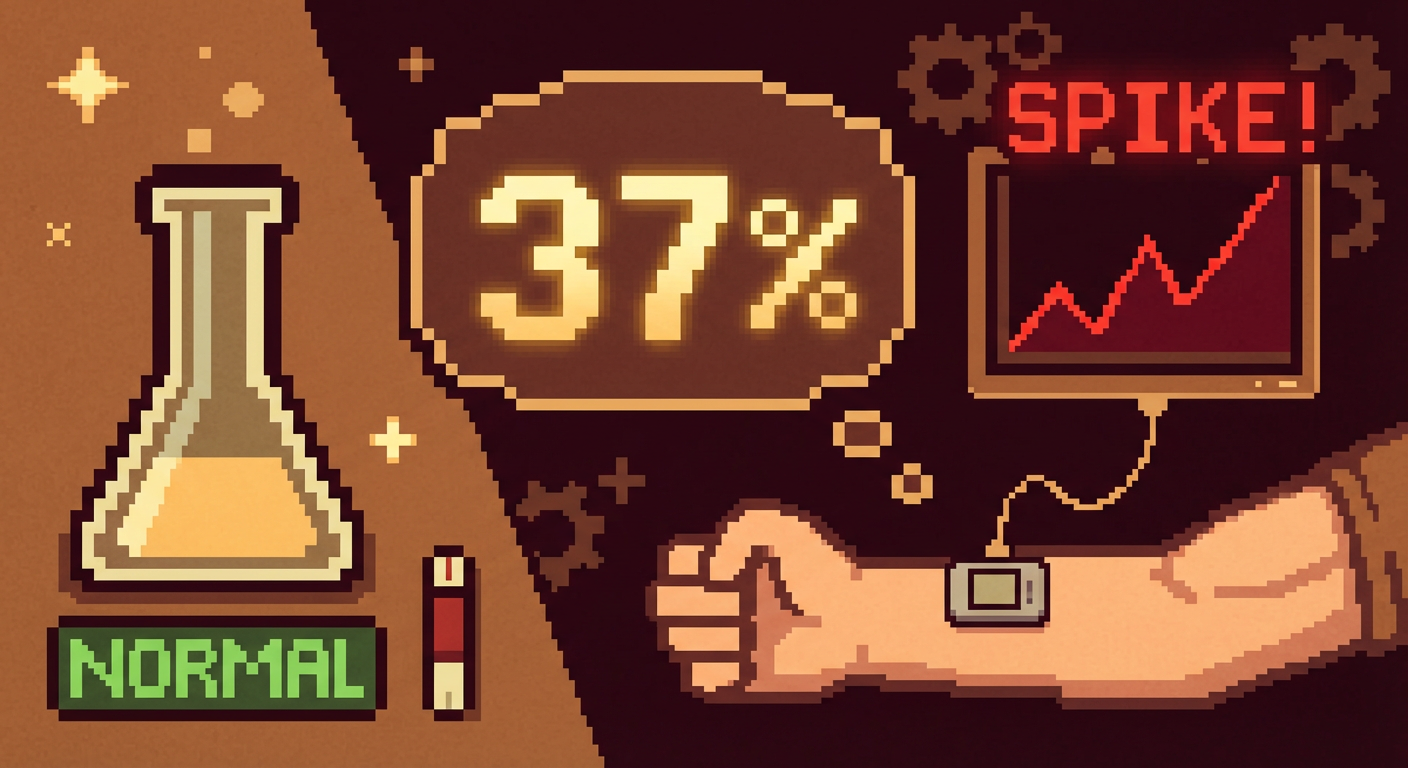
Here’s where things get interesting. A 2025 Stanford Medicine study led by Dr. Michael Snyder examined continuous glucose monitoring in healthy adults without diabetes. The finding that caught attention: 37 percent of these individuals showed unexpected glucose spikes, even though their standard HbA1c tests came back normal. This suggests that snapshots of your average glucose over three months can miss the real-time story happening throughout your day.
That sounds alarming until you read the fine print. A 2025 paper published in Nature Metabolism provides crucial context: post-meal glucose spikes up to 140 mg/dL are actually physiologically normal in healthy people. Your body is supposed to raise blood glucose when you eat carbohydrates. That’s not a malfunction. It’s exactly how the system works. The problem emerges when we interpret normal physiology as something that needs fixing.
This is the tension at the heart of CGM adoption for non-diabetics. The data is real. The spikes are real. But “real” does not automatically mean “bad.” It means you’re getting visibility into something that was always happening invisibly. The question becomes: what will you do with that visibility?
The Anxiety Tax: Why Data Alone Might Not Be Your Friend
There’s a documented phenomenon in health optimization circles called orthorexia: an obsession with eating perfectly that paradoxically reduces quality of life. CGMs, deployed without expert guidance, can accelerate this pattern. You see a glucose spike after your favorite pasta, and suddenly you’re second-guessing whether you should eat it again. You notice your blood sugar climbing after toast but not after oatmeal, and you’ve just eliminated an entire food category based on a single data point.
The research bears this out. Levels Health, a company that combines CGM monitoring with coaching, found in their 2025 annual data review that users who consulted with registered dietitians made more sustainable dietary changes than those who used CGM data alone. Let that land. More data did not create better outcomes. More data plus expert interpretation did.
This matters because sustainable health is built on behaviors you can actually maintain. If your glucose monitoring habit turns into an anxious, restrictive food relationship, you’ve traded one problem for another. That trade almost never works out long-term.
When a CGM Actually Makes Sense for You
None of this means CGMs are bad for non-diabetics. They’re a tool, and tools work best when used with intention. There are genuine reasons to explore one. If you have a family history of type 2 diabetes and want to understand your personal risk profile, actual glucose data beats guessing. If you’ve tried making dietary changes and want feedback on what actually works for your individual body, that’s a legitimate use case. If you’re already working with a healthcare provider or dietitian who can help you interpret the data, even better.
The technology is also genuinely useful for catching patterns you might not otherwise notice. Some people discover they’re more glucose-sensitive than they expected. Others find that their breakfast choice dramatically affects their afternoon energy, and one small swap creates a cascade of improvements. These discoveries matter precisely because they’re personal. Your glucose response is not identical to someone else’s, and that individuality is worth understanding.
Check the FDA OTC CGM Device Clearance Information to understand what’s available and approved for over-the-counter use. If you decide to try one, go in with a specific question rather than just wearing one to wear one.
The Long Game: Data Is Just the Beginning
Here’s what I’ve learned about sustainable health: the exciting interventions are rarely the ones that work long-term. It’s not the supplement you find in March. It’s the 10-minute walk you take consistently in November and February and every month in between. It’s not the perfect macro ratio. It’s the ability to eat in a way that nourishes you and that you can live with for years.
CGM data, used wisely, is just another tool for learning about yourself. It’s not the destination. It’s information that might help you make decisions that actually fit your life. The real win is what happens after you take off the sensor: the habits you build, the confidence you develop, the sustainable choices you make because they work.
The technology is here. It’s accessible. The question now is whether you’re ready to use it as a learning tool rather than a measurement treadmill. If you are, it might be worth exploring. If you think you need perfect glucose numbers to be healthy, then the data will probably just give you another way to feel like you’re failing. Know which camp you’re in before you order one.
Have you tried a CGM for yourself, or are you considering it? I’d genuinely love to hear what questions you’re working with, or what made you curious about glucose monitoring in the first place. The real wisdom often lives in our questions.